Sign up for TPR Today, Texas Public Radio's newsletter that brings our top stories to your inbox each morning.
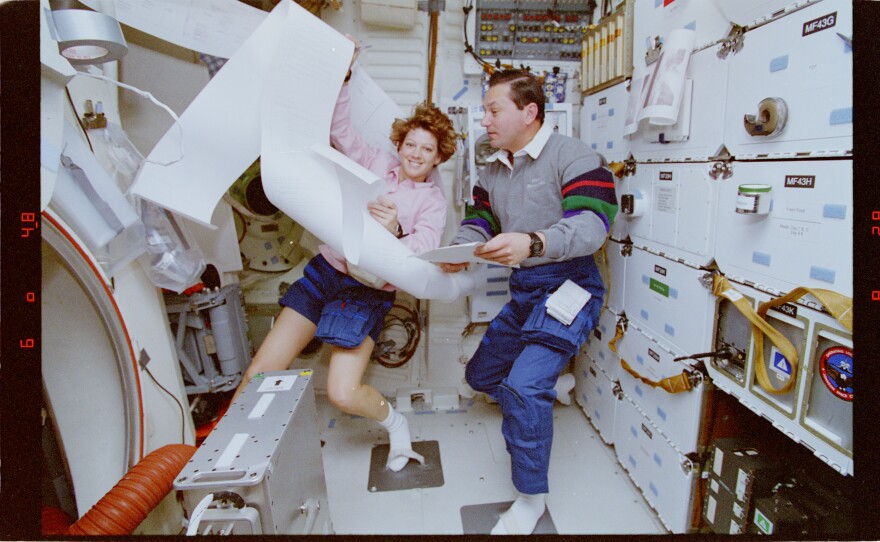
Eileen Collins was born in Elmira, New York, and grew up in public housing.
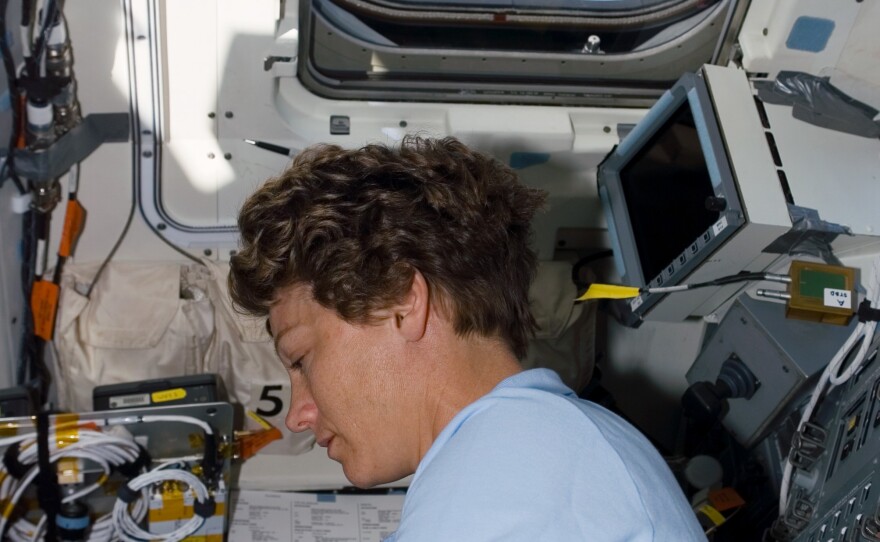
She rose to become the first woman to pilot and command a space shuttle.
Collins’ story is told in the documentary, Spacewoman. Screenings continue through Wednesday, April 8 at the Santikos Embassy near 281 & Bitters.
It screens later this month in Fort Worth and Houston, and will be available for streaming this summer.
We’re talking today with Collins and with the film’s director, Hannah Berryman.
This conversation has been edited for clarity and length.
MARTINEZ: Hannah, I think, when it came to titling the name of the documentary, maybe not necessarily titling it after Eileen’s book upon which it is based, but I don't know. I thought it probably should have been called “The Righter Stuff” or “The Better Stuff,” because it really does paint a picture of Eileen as somebody with “the right stuff.” When you think back on the Apollo missions, the Apollo astronauts, these are all test pilots, and they were used to living on the edge and they were very mission driven. And what I got from this film is that Eileen is a very mission driven, purposeful person. And I get that even today with the astronauts right now that are on their way to the moon and back.
So tell us a little bit about what drew you to making this documentary about Eileen and about the title of the film, Spacewoman, why you chose that word?
BERRYMAN: Well, Eileen wasn't the first woman to go to space. Now she was the first woman to do the “right stuff” bit, which is piloting and commanding. No woman had done that before in a crewed spacecraft.
So for me, Spacewoman was, I felt that she, therefore, deserved the title “spacewoman.”
I was approached by the producers Keith Haviland and Natasha Dack, and they'd optioned Eileen’s book. And I read it. I just was gripped by the story.
And I guess it was the combination of...I hadn't imagined an astronaut coming from so many challenges in her background, and then to be doing these missions that, in themselves, were increasingly challenging and jeopardous.
I thought it was quite a dramatic story space-wise and emotionally because, also, Eileen had her own family. It's just a different experience that I wanted to look at as a female director myself, and just kind of look at both in tandem, really.

MARTINEZ: And Eileen, sort of all the experiences that you had in your life, they did build you up into the person that you are, and you were often the first or only woman in the room at the Air Force to be the first one accomplishing all of the accomplishments that got you eventually into the space program. Can you tell us a little bit about, very briefly, that build up to your finally entering NASA, that road that took you there?
COLLINS: Well, I started in ROTC, Air Force ROTC, I want to say my military career. I read a lot of books as a teenager about military pilots and civilian pilots, men and women, and decided that was what I wanted to do with my life.
Of course, there weren't many women pilots back in those days, but my timing worked out such that the Air Force started a program in the late 1970s. It was a test program: can women fly military aircraft? So I applied to the program. I got selected.


I came here in 1978 to San Antonio. My first assignment was over there at Lackland, and we went out to Hondo to fly T-41s.
From here, I got sent to Oklahoma, where myself and the three other women were the first four women to ever go through pilot training at my base.
And I learned the way you function as a woman in a totally man's world — because there were over 500 men at that base — is to focus on your job. Be the best you can be. Study all the time. Whenever a question came up, I wanted to be the one in the room with the answer, or at least I have an idea of suggestions. So I think being the only woman, or one of a few women, made me try harder and be better.
And so I went on. I loved my Air Force career. I loved the flying. And I spent, I want to say, 16 years at NASA. I flew four times on the space shuttle.
And you had mentioned the book earlier. So I wrote the book Through the Glass Ceiling to the Stars. And Keith Haviland, our producer, read the book. So Hannah and Keith and their team came up with the title Spacewoman. I never thought of that. I thought it was actually a really good name because it's one word, and it's kind of eye catching, and a photo by…
BERRYMAN: Annie Liebovitz.
COLLINS: Annie Liebovitz, who is a famous photographer. She took that photo in the hot Houston humidity with a big fan.
So anyway, the last thing I want to say is the film Spacewoman is absolutely, tremendously a great job, and I think people will be highly … they're going to feel good. They're going to feel happy when they come out of the film.

MARTINEZ: And I heard you on an interview saying that “happy” wasn't necessarily the feeling that a lot of people got when they have screened the film in the past. Some people actually have been in tears, but not because they were sad or it was tragic, but because it moved them so much.
COLLINS: Well, a couple weeks ago, we were in New York, we were showing the film up there. It showed for a week, and it did very well. A man came up to me after one of the shows and said, “I cried through the whole thing.” And this was a man about my age. That's the third person that told me they cried through the whole thing. But I think it's a happy kind of cry.
I also think some people can relate to like, my dad was an alcoholic, and we had ups and downs all throughout my childhood, and I learned to deal with that. I think it made me stronger. It could have broken me. But fortunately, we had my mom, who was very strong, but she had problems of her own. And I was able to watch my parents go through life and overcome problems.
And I think that probably hit home with a lot of people in the struggles that Hannah was able to bring out in the film, the struggles that the astronaut families go through when they watch their loved one launch into space. So our film is not just “Eileen was in the Air Force, and she flew these four great shuttle missions, and here's what happened,” but it's also the human side and problems and struggles and emotions that people deal with.
And I try not to be an emotional person because I find it clogs my thinking. And so the military has taught me to think procedurally, think organized. I have very procedural ways of making decisions, resolving conflict, dealing with mistakes. And I have learned, because of my military training, how to go through life with step 1-2-3-4-5, and always know you can be in a really low place in your life, (but) there's still sunshine on the other side. And I think that that does come out in the film.
MARTINEZ: Well, Hannah, it must be a difficult decision in the editing room floor when you have so much that has gone in Eileen’s life and career, to be able to condense that into less than two hours. Can you tell us a little bit about how you were able to determine what you wanted to keep in the film?
BERRYMAN: I think I'm just always led by the human storytelling. So you set the scene, but then you don't really want to go through everything about Eileen’s childhood. You want to drip that through the film so that as you're understanding her drive to have made it through being one of the first Air Force pilots and then into one of the first pilot astronauts, we flash back to Eileen’s background. You start to understand how she got her strength and resilience, really.
And so I hope that, in the end, the film is kind of a film about emotion and control, but it's also a film about resilience, and maybe the things that don't break us in life can make us. And so that's, I think, probably the optimistic feel of the film that Eileen is talking about, that even though people are emotional. It's quite an uplifting film, maybe.
And in terms of the space details, that was tricky, how much to put in each mission. So I think we tried to keep it to something significant about each one, and we couldn't explore everything. And also we were guided by the stuff. We had a great archive. We had an amazing NASA archive, an amazing personal archive that Eileen had saved, reams of tapes that Pat (Eileen’s husband) had shot. And so sometimes you're led by the archive moments, and they're the things you explore.

MARTINEZ: And you had these amazing interviews with some of Eileen’s former shuttle mates and with her family as well. And Eileen, when you first saw the film and you saw the interviews with your family, did some of what they said surprise you in any way?
COLLINS: Well, yeah, so before we took the film public, Hannah and Keith, our producer and their team, showed the film to myself and my family. And it was good to do that, because we could get a look at kind of, I want to say, process what everything was going to be about before it went public. And yes, there were some things that surprised me.
My daughter's … I told my daughter, “You don't have to interview if you don't want to,” but she wanted to.
So the film takes from her birth all the way up to today, and how we had some issues, mom-daughter, which I won't have time to go into now, but it really comes out in the film, her being maybe upset and a little bit lonely that her mom was going up in space, but how she was able to, I think, grow stronger from that. And she was worried so much about the fact that the mission before mine was an accident and the seven astronauts lost their lives
MARTINEZ: Columbia.
COLLINS: That was the Columbia accident in 2003 and my mission (STS-114) was the next one up. And of course, it was over two years before I actually flew the mission. So Hannah explores the tough and scary emotions that mostly kids go through. I mean, spouses do, too. And my daughter has a line in the movie where she said, “We all watched the launch go up, and everybody was crying.” And I can see that because I was a family escort, and I used to be with families while they watch their loved one blast off into space. It's a physical moment. When you watch a launch, it's not just the emotion, but it's the light, it's the sound, it's the vibration, the building shakes under your feet. It's like a whole-body experience.
And I think in Spacewoman, we have, we have scenes of my shuttle launches, and the way they have the sound in the music, it's just wonderful. I mean, I love watching the launches over and over again in Spacewoman. I mean, I have to rewind and play it again!

MARTINEZ: And again, let's talk a little bit about the score, because the score, and if you are not paying attention to it, and I think good score is supposed to help with the mood of the film, but not be overwhelming. And I think you found the perfect balance with it. Can you talk a little bit about that?
BERRYMAN: So the music in films is really important to me. So right at the beginning, we were me and Natasha Dack particularly, talking about who to work with, and Marcelo Zarvos, his name came up. Now, he's an amazing kind of Hollywood composer, and I've temped with his music before and always wanted to work with him.
And we sent him the taster, and he said he got goosebumps, and that's his indication of whether he wants to make a film. And so we worked together week after week. We —me and Marcelo and the editor, James Gold — we got on Zooms. We spent hours talking about the music, playing sections of the film, playing bits over that he was working on, talking about what was working what wasn't. So you just spent months and months crafting that score that you later hear that he recorded in Budapest and Prague. It elevates the film, I think, when you have that.
MARTINEZ: And Eileen, I think this film could not be coming out at a better time right now. With Artemis II, it just seems so serendipitous for all of it to be happening at the same time. And those of us who remember Challenger who remember Columbia, I think all of us had that knot in our throat: can they get past that first 73 seconds of launch? And they did, and now we're all just gonna have to wait until they splash down, because we now all have that memory of Columbia.
But you and other astronauts know what the mission is, and you know that space flight is risky. And I remember reading Deke Slayton’s and Alan Shepard's book, Moonshot, and pretty much every single launch was fraught-ridden. One was even struck by lightning.
And so I again, it just sort of reiterates that space flight is dangerous. Talk to us a little bit about why we should be invested in the space program now? Because we have this past trauma that America and the world is dealt with these past experiences, but the mission must go on.
COLLINS: Yeah. Well, first of all, I want to say, on April 1, I watched the Artemis launch. We were in Austin, showing Spacewoman up there, and the timing was set right before Spacewoman. We all went over and watched the Artemis launch. So we all got pumped up.
I was so nervous watching. I know the four people, the astronauts on board, and I know what the risks are. And I was praying, praying, praying, and it was such a huge relief to me when that launch went up, and I was just so happy afterwards.
And of course, my phone's been ringing off the hook, but my dedication right now is to Spacewoman.
But to answer your question about why we're doing this exploring, humans have a need to explore. And if you look at the history of humanity, you can go all the way back to ancient Greece. People got on boats, and they went out on the Aegean Sea and the Mediterranean Sea, and they're like, “Oh, there's probably some scary monsters in the water that are going to eat us.” But they went anyway. And people left Europe, and they came to the New World back in the 1500s. And the explorers, which I read about, I love that they were willing to take those risks to go out. A lot of it was economically motivated, but I think a lot of it was just, why would they go if they know they're going into danger, but they went anyway.
And we're doing the same thing today. We will build research stations on the moon. We will do science up there. We will use it as a base to go other places, like Mars.
All of the equipment that we take to the moon will have to be worked out to make sure that it's not going to fail, especially the life support equipment needs to be reliable so our astronauts have air to breathe and water to drink and food.
So we'll work all of that out at the moon, which is only three days away. Now, I know the Artemis crew is going to be a 10-day mission, but they're actually taking a wide swing around the back of the moon. Future missions will land on the moon, and you can get there in three days.
Future missions to Mars are six months. So you can't really call a repairman or ask for a spare part to be sent up. Fortunately, we have technologies. You can do 3D printing and we're learning how to recycle water. In fact, on our space station right now, we recycle 97% of the water, plus. We're having some little issues with the carbon dioxide removal. That's tricky, but we're learning.
And once we really get those technologies refined to the point that they are reliable —that's our risk management program — we'll go to Mars. I'll tell you, every single astronaut would sign up to go to Mars.
I mean, not everybody wants to go, but people are different, and that's okay.


MARTINEZ: Eileen, you are a San Antonio resident. What do your days look like when you're not promoting the film?
COLLINS: Well, first of all, I love San Antonio. It's my favorite city in not just the country but the world. And people say it's a big city with a small-town atmosphere. That's definitely true.
I love the military atmosphere. We have USAA here. I was on the USAA board of directors for 15 years. Love the company, love the military. In fact, my mother-in-law was born here. She lived on Cherry Street way back. She was born in the 1920s. And I have extended family here on even on my side. So I'm kind of an immigrant into San Antonio, but I'm very proud of being here.
MARTINEZ: Well, I wish I could talk to you both for a few more hours, but I know we have to wrap it up. Eileen Collins and Hannah Berryman, thank you so much for talking to us today.
COLLINS: Thanks.
BERRYMAN: Thanks for having us.