Sign up for TPR Today, Texas Public Radio's newsletter that brings our top stories to your inbox each morning.
Patricia Castillo has spent over three decades working to end violence against women and families. She said that for the first 25 years of her career, she refused to work with male perpetrators. Now, she says men need to be part of the solution.
“Because I was raised by the white feminists that taught me that the men were the enemy. And that was their thinking back in the '70s, '80s, right,” Castillo said. “And you know, [they told me] ‘don't waste your energy, Patricia, on men. We need your energy, your expertise, your knowledge, your passion for women.’”

Castillo is the co-founder and executive director of the P.E.A.C.E Initiative (Putting an End to Abuse Through Community Efforts), an organization dedicated to educating the community on the dangerous, often deadly consequences of domestic violence. She said the majority of the women she has helped did not want to get a divorce, move out of their neighborhood, or for their kids to grow up without a father. As time went on, Castillo said she could not ignore what women kept asking for: to help their partners stop being abusive.
The domestic violence issue in San Antonio
One in three women and one in nine men in San Antonio experience domestic violence (DV), also known as intimate partner violence (IPV). That's according to the Collaborative Commission on Domestic Violence (CCDV), which defines the main behaviors identified within DV as physical, sexual, emotional, and financial abuse.
The prominent presence of this abuse, specifically the disproportionate impact toward women, is not unique to San Antonio; the National Institute of Health has named it a global public health issue. San Antonio does, however, have the largest rate of domestic violence in Texas. To put this in perspective, the San Antonio Police Department and Bexar County sheriff’s deputies report that they respond to nearly seven DV-related calls per hour.

Judge Monique Diaz, the co-chair of the CCDV, says these high rates of reports mean that people in San Antonio are reaching out for help. However, it is still estimated that a large number of domestic violence instances go unreported. The committee also found that abuse may be less reported within Latino communities because of barriers like language access, immigration concerns, and cultural stigmas such as machismo.
How men can be part of the solution
During the International Women's Day March organized by Mujeres Marcharan, over 200 people gathered around an installation. Strung across long lengths of string were 224 pieces of paper, each one bearing the name of a woman killed in Texas last year due to gender-based violence, or femicide. There were few men at the march. And for many working to prevent intimate partner violence, that’s part of the problem.
Local attorney Manny Peláez said it should not fall on women to educate men on this topic.


“Whenever it's time to attend a gala for a domestic violence program, whenever it's time to raise money, you look around those rooms and it's almost exclusively women. And men don't necessarily see other men calling them to the table,” Peláez said.

Peláez an attorney and former district 8 councilman, says growing up with an abusive father shaped his decades-long work in domestic violence prevention alongside his mother Marta Prada Peláez, the CEO of the Family Violence Prevention Services. He said the issue of domestic violence will not be solved unless men join the conversation and call out other men when they demonstrate unhealthy behaviors toward their partners.
A local initiative called the San Antonio Fatherhood Campaign is working on this exact issue. Through free weekly classes offered to the public, the initiative helps men and fathers improve their self-esteem and learn to engage in healthy relationships. The campaign is under a local nonprofit called American Indians in Texas at the Spanish Colonial Mission (AIT-SCM).

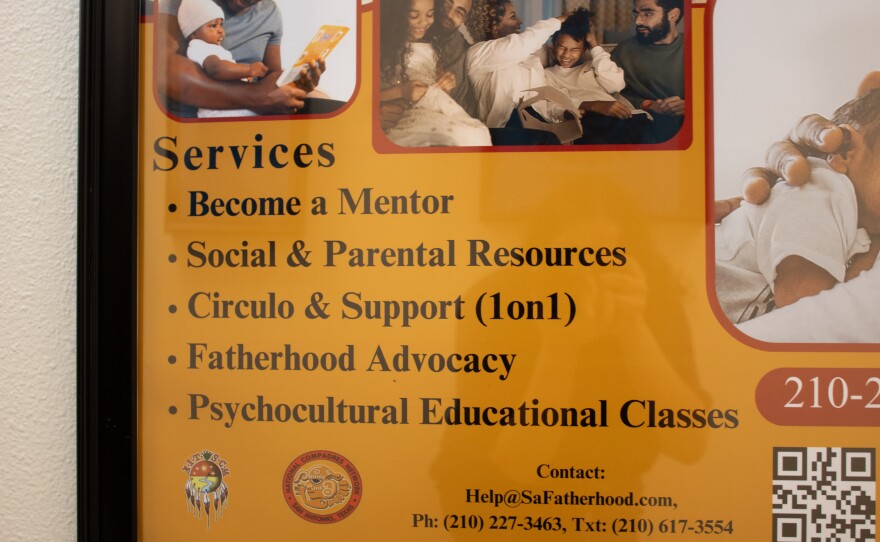


“We have this teaching that we do about ‘crossing the bridge.’ Where, you know, it's a man's bridge. You have to cross it, and what happens is that a lot of these men get stuck in the center of the bridge,” AIT-SCM executive director Ramon Vasquez said. “It's due to alcoholism, substance abuse, and other acts that they've engaged in that have just kept them stuck on this bridge. And young boys have to cross that to get to manhood.”

Greg Marshall, the program director of the Fatherhood Campaign says the program teaches that abusive behavior is often rooted in power and control.
“That means I need to take control of you for me to feel better, and if I can fix you, my world will be better. But that's not the answer, because I'm still miserable inside, until I start taking ownership for that, until I start realizing that I'm responsible for my thoughts, my feelings, my behaviors. Until that happens, I'm still going to be miserable,” Marshall said.
How machismo perpetuates domestic violence
Vasquez says domestic violence is not unique to the Latino community, it is a public health issue that occurs in all ethnic groups. Because of the large Latino population in San Antonio, the campaign works closely with students to redefine machismo: the Latino cultural construct of exaggerated masculinity. Vasquez says that to redefine machismo, their program teaches guys about the difference between maleness versus manhood.
“Manhood is about responsibility. It's about accountability. It's about being someone of your word. Do people believe what you say, when you say you're going to do something? Being a person of character,” Vasquez said. “Taking responsibility for your children, your spouse, your community, and when you do something wrong, do you stand and be accountable for your actions?”
Dr. Esteban López is a local Latino internist and pediatrician. While he is not outwardly a DV prevention advocate, he said his love for his daughters has made him want to engage in the conversation. He said he too had machismo traits that took him a while to unlearn — traits that he picked up from male relatives.

López admitted to cat-calling women as a teenager. He said that it was a behavior he learned from other men he saw while growing up and that it was accepted in society through shows he saw, referencing the Looney Tunes cartoons.
“I thought I was paying them a compliment, unknowing that it was unwanted attention, or how it could make that person feel scared,” López said. “And I think most men who do it may not understand that they're scaring women by doing that.”
When he became a father to a daughter at the age of 19, he began to realize that his actions or beliefs were harmful toward women.
“I think more men need to keep that insight about the women in their lives,” López said. “Because how they treat other women, how they treat the women that are not part of their lives, the same thing is happening to the women in their lives by other men.”
How to engage in difficult conversations
Peláez points out the difficulty in confronting a friend when they disrespect women.
“You know, men are also like women. We're all a little bit allergic to being lectured to, right? And so I think it's important for men to remember that it's okay to be your brother's keeper, Peláez said.

Marshall provided insight into how men can have these conversations with one another. He suggested being humble and admitting one's faults as well.
“Then we look at them and say, ‘by the way, I see you when you're talking to your wife or the mother of your children, right,'" Marshall said.
Marshall recommends people use the name of the woman they're talking about.
"‘I’ve seen you talking to Samantha, right?’ Because that's a person. 'If that was your daughter, how would you feel to see a man talking that way to your daughter,’" Marshall said. "And we connect them to that moment right now. We might not be better all the time, but if I could be a little bit better today and a little bit better tomorrow, that helps.”
Organizations like the Fatherhood Campaign, P.E.A.C.E Initiative, the Bexar County Family Justice Center, and Family Violence Prevention Services provide spaces and resources to learn how to help prevent domestic violence. The leaders of some of these organizations remind people that raising awareness and prevention can be as simple as talking about it with the people you know.