
Sign up for TPR Today, Texas Public Radio's newsletter that brings our top stories to your inbox each morning.
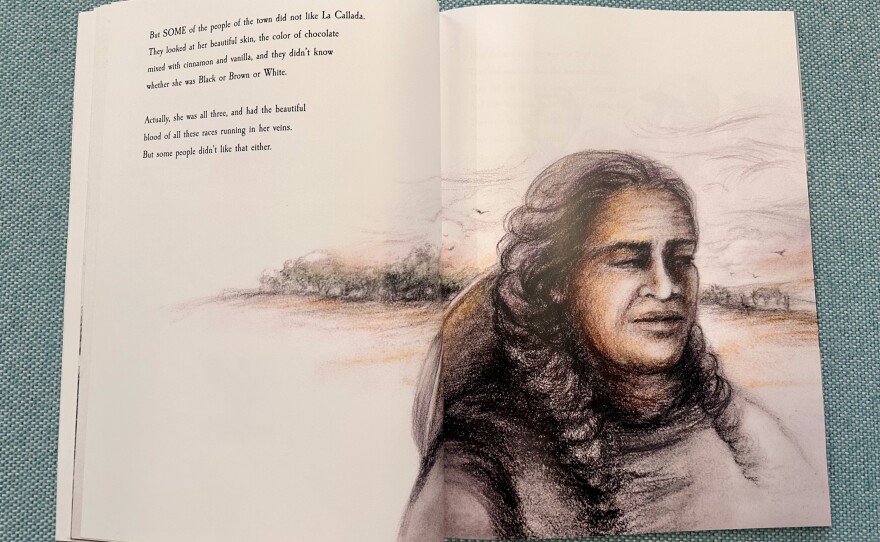
“The Donkey Lady: A Graphic Parable” is a new young adult novel that chronicles an iconic San Antonio urban legend.
The story reclaims the long-whispered tale of a woman who becomes the victim of intense violence by highlighting the humanity that can be found within a community. The book launches nationally this weekend with Aztlan Libre Press at the Esperanza Peace and Justice Center from 3 to 6 p.m.
TPR's Marian Navarro spoke with the book’s author, poet Carmen Tafolla, and illustrator Thelma Ortiz Muraida ahead of the June 20 event.
Tafolla said the tale has deep roots in San Antonio.
Stay tuned to hear more from "The Donkey Lady" on a future episode of TPR's "Fronteras."
TAFOLLA: As with most folklore, it varies so much and each generation enriches it. Each generation adds their own story. So, I wanted to go back to the earliest version of the Donkey Lady that I had heard and find out what was in common between these old tales. And they all had three things in common: She lived alone, so she was vulnerable; She was of mixed race; She had been burnt, horribly burnt in a fire.
In some of the versions, she dies. In some of the versions, she lives. There's never a clear explanation of why the donkey is involved. Many of them attributed it to the looks of her face as she was being burnt or the sound of her screams when she was being burnt.
But there was always a moment of silence in there when they'd say, “¡La quemaron! ¡Pobrecita!” So, there was compassion coming through. So I thought, well, they're telling this scary story, but the monster in the story is not her. The words that I used probably aren't the same words that the original person, whom we now call the Donkey Lady, used. But hopefully the spirit of the story is the same because I tried to listen to the silences. When you listen to folklore, I've learned you have to listen to the silences — what's being said in the silences. So, I tried to give it relevance to today by staying true to the spirit of the original.
That’s how the book came about the legend. I've done some research. Thelma — my good comadre and an artist and illustrator of many of my books — she also went and did artistic research, visual research at the Donkey Lady Bridge.
NAVARRO: Tell me a little bit about that research, Thelma, and what you remember of the legend and what you found?
MURAIDA: It was my father that really told me all these stories. He was so big into telling us a lot of human stories of people in the West Side, on the South Side. There was a point where we crossed the Donkey Lady bridge and he told us briefly about it. There was a woman here who lived in this area and that she was burned. Those stories sort of connected with me.
My father has influenced me in my art, but I also researched how am I going to convey this story in the right medium? I know a lot of children's books are in color and bright and cheery. But there's also something deeper in this story, and I felt I needed to use just the earliest form of medium, and that's charcoal. So, I drew the whole story in charcoal and pastel. What's beautiful about charcoal is the values that you get of the deepest black in contrast to the white. Those shadings kind of helped when I felt I needed to tell the story in that way. So, I chose that medium.

NAVARRO: Tell me a bit more about the significance of having these legends, these stories — in this case, this is very San Antonio, this is very unique to us — but what is the significance of wanting to highlight these folklores and these stories?
TAFOLLA: Culture is a survival kit. It’s what our families and our communities give us to help us survive and folk legends become a form of parable. We have called this The Donkey Lady: A Graphic Parable, because parables cause you to reflect on a moral dilemma, to come up with your own ethical solution. They don't tell you the moral of the story — you figure it out yourself. A lot of urban legends are parables.
But in particular, when culture passes on these legends, the reason people repeat them is because they find meaning in them. If they didn't, they wouldn't remember the story. They wouldn't care about it. But something about the story impacts them so heavily that they have to repeat it to others.
One of the things I think about when I write anything that's going to be read by children (because) this book is for children and adults. It does portray violence, it does portray hatred and prejudice, but it also portrays kindness and oneness with nature, and an acceptance of things and human beings, differences. It shows both sides.
So, in here, I say, be careful who you show this to either very young children or very close-minded adults, would not be good prospects for reading this book. But what it is doing, it's giving messages. She is different. She lives alone. The community whispers about her. They think she's weird. She must come from someplace far away. She doesn't talk much. And her responses to that show us options.
MURAIDA: I think in stories like this, whether for children or adults, it would inspire dialog for people — even a parent to a child — to understand some of the issues that surround us in daily life. But to have a discussion would be really valuable.
NAVARRO: There’s an event June 20th, at the Esperanza Peace & Justice Center centering on The Donkey Lady. Tell me a little bit about that and what we can expect.
TAFOLLA: We will have a dramatic reading of The Donkey Lady in a very spooky setting. I don't think anybody's going to have a heart attack over it, but they may feel a little bit of spine tingling at certain points. It's a very short book. It's a folk legend and people didn't like folk legends to go for an hour long because they told them at the end of the day, and they were tired.
So, you had to put all your oomph into a short period, so we think it takes about 20 minutes to do the dramatic reading. We'll take question and answer with the audience and then starting at about 4 o'clock we're going to have the music of Juan and Armando Tejeda. Juan Tejeda — founder of the Tejano conjunto festival and a noted accordionist — will be playing music for us.
There'll be refreshments hosted by the Esperanza Peace and Justice Center. It's free and open to the public. We'll have an exhibit of Thelma’s artwork up, as well as copies of the book for sale and a chance to visit and take pictures. We see it as a wonderful Saturday afternoon celebration.