Sign up for TPR Today, Texas Public Radio's newsletter that brings our top stories to your inbox each morning.
A lifelong dream and a case of imposter syndrome drive the story of SweetNess, a short musical film by Vanessa Rae Lerma, producer, director, and writer of the movie.
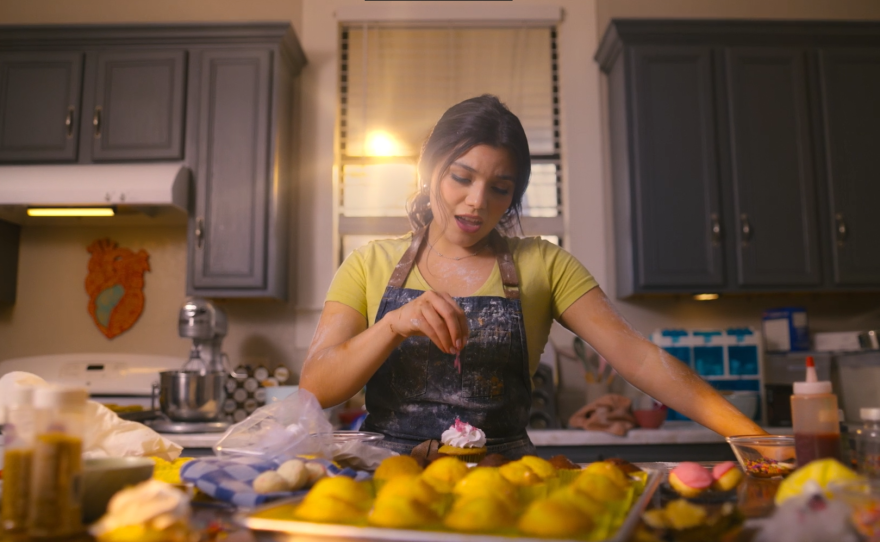
Ines is a successful home baker in San Antonio with a dream to have her own stand-alone bakery.
Lerma is producer, director and writer of SweetNess.
She explains why she chose to tell this tale as a musical.
This conversation has been edited for clarity and length.
LERMA: So, I spent almost, I guess it was 13 years as a theater teacher, high school theater teacher. So, my background is a lot of musicals and a lot of plays. And since COVID, that's when I left the education field. I haven't directed a musical since. I've always wanted to be a part of an original musical, original score, and I wanted to make a film, and I figured, let's just go all out and see if we can pull this off.
MARTINEZ: And it requires a collaboration, right? Because it's not just your words as a writer. You have a lyricist, you have a composer, and you have to find a way to collaborate in order to make that all happen. Can you talk us through the process of doing that in this film?
LERMA Yes, so that all comes down to trust with your collaborators. And so, I reached out to one of my dear friends — and he and I have been working together creatively since 2008 — and he's our lyricist.
He's an amazing playwright, amazing everything. He also composes, but he recommended a couple of people based on, like, our conversations, and one of his collaborators is Jaime Lozano. So, the lyricist is David Davila.
Jaime Lozano is in New York City. That's how David met him. But he is from Mexico, so he gets the vibe that I was going for, and he does a lot of musicals and off-Broadway/Broadway productions.


MARTINEZ: So tell us a little bit more about the music that was provided by Jaime Lozano.
LERMA: Yes, Jaime Lozano, I hadn't met him until last month in person, but he and I had been collaborating over Zoom, over messages, voice memos for the last year.
But Jaime is … I can't even describe it. He's so good. He's amazing, and he understood what we were asking for. We were asking for something that was musical theater inspired with South Texas flair. And all of his musicians are in Mexico. They're in Monterrey and he's in New York.
And so, he wrote the music and just took the film to a whole other level that I couldn't do. I can't do that by myself. I can't do the lyrics, all of that. I feel like his music just really brought it to life.
And he worked on In the Heights, the movie. He did some orchestrations for that. And recently had orchestrations on Real Women Have Curves on Broadway as well.

MARTINEZ: Casting is also really important. So, in this film, you have the lead character Ines, and then you have her tía (aunt), Tía Amalia, who, they're almost clashing personalities, because she (Ines) just seems very sweet. She's a little insecure, but her Tía Amalia is very brash and very almost profane a little bit, but in a loving way. But always so, so supportive of her niece and she's the mother figure here, since we learned early on that Ines has lost her mother. So, tell us a little bit about that dynamic between those two characters and how it may have been influenced by you and your own personal life.
LERMA: Ines, I really wanted her to be a little more timid. I wanted her to, I feel like, as an artist, everybody suffers from imposter syndrome. And so, I feel like I really wanted to show that even though she's producing good, quality products, somebody always needs a champion.

And I was looking for somebody that felt very San Antonio, and I cast Ines with Elizabeth Raquel Ramirez. She's a former student of mine, so I've been working with her for 10 plus years. So that role was written specifically for her and Amalia. I had I envisioned somebody who looks exactly like Marisela. And so, when Marisela Barrera, she's local. When she auditioned, I was like, “Oh my gosh, that's what I pictured in my head.” So it was definitely meant to be. I was so happy that she auditioned.
MARTINEZ: And so tell us about the inspiration. I know that you were a baker at some point, and so there's a little bit of yourself, or maybe there's a lot of yourself in this film.
LERMA: Yeah, so I worked in a couple of bakeries in college, and worked here in San Antonio, in New York City, and taught cupcake decorating classes. But I found out a couple years ago on Ancestry.com that my great grandparents were bakers. Like, their cards from Mexico said, “occupation: baker.” And I called my mom, and she's like, “Oh yeah.” They opened up the, I think it's La Popular here in town. And my mom's grandma would bake for them in the house all the time. So, my mom always had fresh pan dulce.
And I was like, “You're barely telling me this?” I'm like, “where are those recipes?”
It all made so much sense to me. I was like, wow. So, it's literally in the blood that I've always been drawn to this art form. It's an art form. And my mom used to bake, too, growing up, so I watched her bake and decorate, and my sister also bakes, too. Not for jobs, but for fun.
MARTINEZ: And there's a lot of that San Antonio-ness that comes out of this film. The colors are really bright and beautiful. And even though, again, it's a short film, you really get a good encapsulation of who and what San Antonio is through the film, the cinematography, through the characters. Can you talk a little bit about that purposefulness of doing that?
LERMA: Yes, I'm so glad that you say that. I always feel like when San Antonio is depicted on screen, whether it's in Hollywood or it's set here, it just never looks like our city. And people who think …they have an idea that maybe we ride horses or something. But I wanted to really showcase what our city looks like and what the people look like and what we sound like.
We don't speak in full English, even if we don't speak Spanish, there are Spanish words that come out. And it really doesn't matter your ethnicity, like everybody enjoys a bean and cheese (taco) or some kind of pan dulce in this town. So, I really wanted to showcase that. And I feel like we're such a city full of art. The city runs on art, and I wanted to showcase that with colors.

MARTINEZ: And a lot of emotion in this film as well. It really does take you on highs and lows, and it's a film that you still think about when it's over. And I know that sometimes it's hard to write that, but it's all usually in just, again, that collaboration between the filmmaker and the actors in order to make those emotions, to have those reflected in the audience.
LERMA Oh yes. I wrote it, but the lyrics and the music also play so much a big part of this. There were so many conversations I had with our lyricist on what can we say that's not already being said with the dialog? He's in LA, actually. He's from here.
But we just had these very lengthy conversations: What can we say about her past? What can we say about her mom who's not here? How can we let the audience know and take them on a journey lyrically, musically?
And then I wanted it to pass the Bechdel Test
MARTINEZ: For people who don’t know, what’s the Bechdel test?
LERMA: The Bechdel Test is where you're not looking for a love interest. The last project I did — so much fun — but it was a high school sitcom-y where girl-wants-boy, boy-wants-a-girl. And I wanted to try something different and see if I could do that. And so this was more of a love for her passion and a love for her family, for her tia and vice versa.

MARTINEZ: Well, give us some of the details on the screening that's happening today, March 11.
LERMA: Yes, so today, March 11, we're going to have our exclusive premiere at TPR. We're going to have a market at 6pm where we're going to showcase women vendors, women entrepreneurs. Then the screening will begin at 7:30. So we'll have several things. You can go support vendors, take some pictures on the red carpet, and then watch the film.
MARTINEZ: And we are looking forward to that. So much. Vanessa Rae Lerma, thank you so much for talking to us today.
LERMA: Thank you for having me.