

As the Trump administration's plans for border walls in the rugged Big Bend region of West Texas advance, landowners in the path are struggling to understand how the plan could impact their homes and livelihoods.
Amid a lack of details from U.S. Customs and Border Protection (CBP), advocates are rushing to help landowners with legal aid in sparsely-populated rural areas along the Rio Grande, where local residents have started receiving government letters threatening the seizure of land for the project.
David Keller, with the newly formed advocacy group No Big Bend Wall, led a landowner meeting earlier this month in Redford, a small community outside of Presidio on the Texas-Mexico border.
Border wall plans have never progressed this far here before. In recent weeks, locals opposing the wall have rushed to form a landowner coalition, coordinate legal access and educate landowners on their rights.
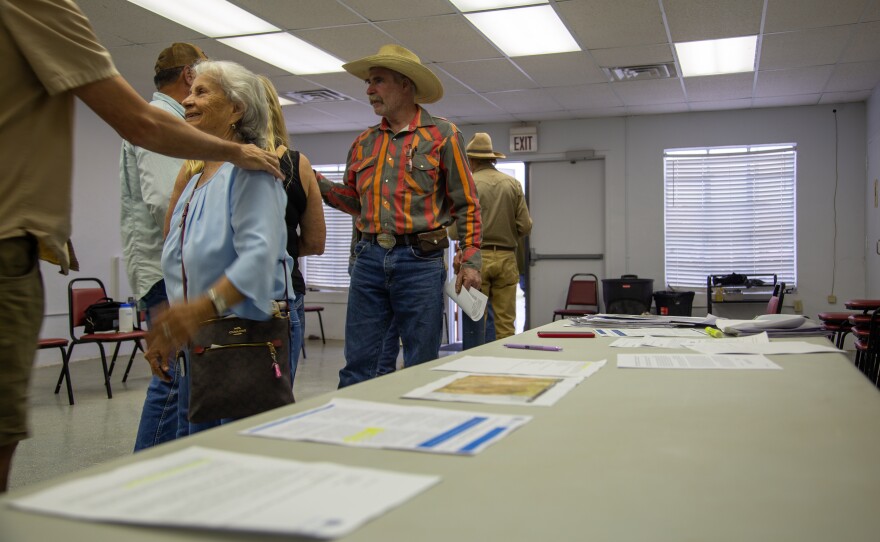
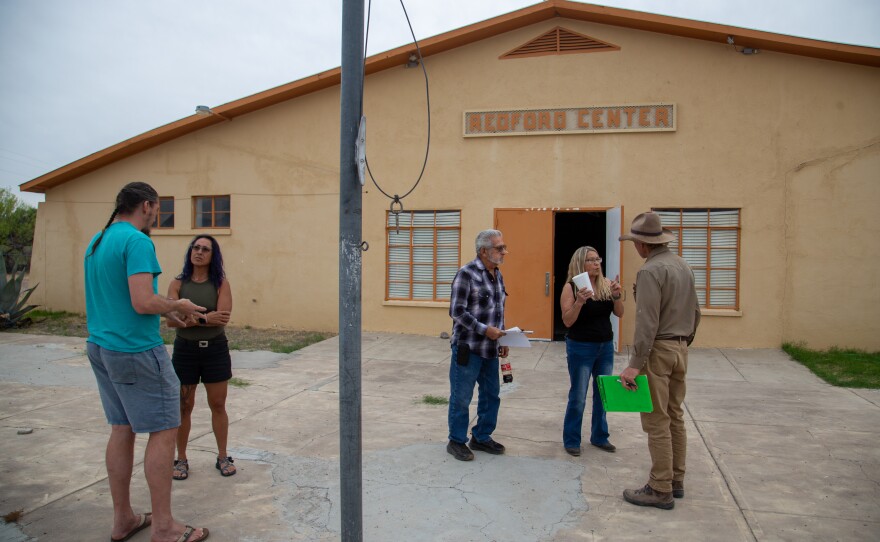
Keller, who lives in Redford, said letters seeking landowner authorization for border wall construction are stoking fear and anger.
" Most of them don't have attorneys on file," he said. "Most of them…English is not their first language, and this is written in coercive language."
He's been urging his neighbors not to sign anything and to lawyer up.
"We're all in this fight together and we gotta have each other's backs, man," Keller said at the recent landowner meeting. "And if you know people that you feel are gonna sign, you know, talk to 'em and try to get 'em not to."
Local farmer Esteban Mesa has a property in Redford that backs up to the Rio Grande. Mesa and other farmers pump water directly from the river to their fields. He said a border wall would cut off access to his pump, making it impossible to irrigate.
" I know that they're not gonna – with the way this valley is – they're not going to be putting a gate at every property owner's property," Mesa said.

Mesa lives on a farm that has been in his wife's family for 150 years. He gets emotional talking about the dedication it takes to run these family farms despite mounting challenges of drought, climate change and now the border wall.
" And the majority of the true, true family farms and ranches, people have to work offsite to make a living because it's just so very, very difficult," Mesa said. "But it's in the blood, it's like, you just can't walk away from it. I mean, it's a legacy. You know, passed on."

Redford was once a thriving community, with a schoolhouse and an acequia – the Spanish term for traditional irrigation ditch systems – that brought river water to farms. But the school has long closed and the acequia now runs dry. The families that still remain, despite the odds, have been there for generations.
Mesa's neighbor, Armando Carrasco is from one of the oldest families in Redford, and lives across from a church where mass is still held once a month.
He said he's concerned about how the wall would impact flooding and the town's levee.
" We have several arroyos between here and Presidio," Carrasco said. "And so how are they going to build a wall through those arroyos?"

While CBP has already awarded more than $3 billion in contracts for wall construction in the area, its urgent pursuit of the project has led to botched communication with local landowners.
Mesa said he hasn't received a single letter from CBP. "Right now my frustration is, I wanna be able to have a voice," he said.
Other landowners have received letters from CBP asking them to authorize border wall construction on property they don't even own.
Cynthia Ramirez, Presidio County's chief property appraiser, said the U.S. Army Corps of Engineers is relying on the appraisal district's maps – which lack a certain level of detail – to locate landowners.
Generational land along the river is complex, she said. Surveys are lacking and the land has been subdivided. Ramirez said she's seen cases of CBP sending letters out to every property owner within a section of land – 640 acres – regardless of if they are near the border or not.

" Because if there's multiple owners in a section, they're overlapping on top of each other, the parcels," she said. "So they're not gonna be able to pinpoint exactly where Jane's property is because she doesn't have a survey."
The federal government is spending $17.6 million dollars per mile for the wall plans in a poor region struggling to afford basic infrastructure like ambulances and running water. Many, including five local sheriffs, say the wall simply isn't needed.
Carrasco sits underneath a metal pavilion surrounded by farm tools and machinery at his property in Redford. He said if the wall isn't needed, why limit local farmers' movements on their own land?
"Why go through that expense?" he said. "Why change the way things have always been here? We're free."
CBP has said border wall construction would start toward the end of the year. It's unclear when the government might start condemning land for the project. The agency is currently taking public comments on the plan until April 6.
CBP did not respond to a request for comment for this story.
This reporting was made possible by generous donations from supporters like you. Please consider making a donation to Marfa Public Radio to fund the journalism you rely on.
Copyright 2026 Marfa Public Radio