

José Noé Mendez celebrated his 101st birthday flying over South Texas in a Boeing PT-17 Stearman biplane. It's an aircraft type he once helped maintain before his years of active service during World War II.
"I had experience in flying before," he said. "I didn't get the license, but I took a course in flying, and I was flying small planes."
These days, Mendez is able to talk about his combat experience from the war. But for decades, he kept his story closely guarded.
He was awarded the Purple Heart and three bronze battle stars during the World War II campaign. Before that, he left his grandfather's ranch in Benavides for Corpus Christi to enter service.
"When I came from being a Boy Scout, at the age of 17, I dropped out of school and came to Corpus and heard of it," he said. "The Navy was asking for people to come and train for aircraft mechanic."
Mendez was deployed a year later to Europe during World War II, serving seven months on the front lines in the United States Army's 1st Infantry Division, referred to as "The Big Red One," under General [George] Patton.
During the war, Mendez was a machine gunner. While on night patrol assignment, he was severely injured by a hand grenade thrown by a German soldier. He was carried by a fellow soldier to a command post where he lay injured for 12 hours, rapidly losing blood. He later woke up to the voice of a nurse at a field hospital in England.
"My name is José, and she called me Joseph," he said. "She says, 'Joseph, wake up, because they're gonna put you in the body bag. They're gonna send you back home in a body bag.' And she said, 'I've been here with you three days, and I'm not gonna leave you alone because you look so young, and I don't want you to die.' "
There was no way he could communicate to his family where he was, or even if he was alive. In addition, he had a brother who was also serving the country. The family received a telegram in December 1944 that Mendez had been missing in action for several weeks.
"But I was thinking about my mother because during the time that I got in the forest, they didn't know where I was, so they sent home a telegram saying that I was missing in action, and it almost killed my mother," Mendez said.

After recovering for two-and-a-half months, he returned to the front lines. As wounded soldiers were considered fit for duty, they were sent back into combat.
In one of the battles that Mendez and company fought, they spent four weeks in Central Europe against enemy troops and harsh conditions in the Battle of Hürtgen Forest in the winter of 1944.
"We were just like stray cats, you know," he said. "And that was another 28 days without taking a uniform or change shoes or anything. Hard to get food. We couldn't get no no warm meals or nothing like that."
Without any commanders, maps, direction, or communications, the soldiers spent Thanksgiving, Christmas and New Year's in below-freezing weather. Mendez said even starting a fire for warmth would have put them at risk.
"We were told if you see anybody starting a fire — because the smoke will give our positions away — you have to shoot them," he said. "You get shot. We couldn't start a fire nowhere to warm a meal or anything like that."
Mendez and his comrades were also ambushed by German soldiers. The 99th Infantry Division of the American First Army was wiped out. Troops were killed or taken prisoner, which put pressure on the remaining soldiers. Mendez's lieutenant wanted to surrender after the ambush. But he had a problem with the lieutenant's plan.
"I [said], 'Look, I travel all the way down here from South Texas, 7,000 miles, I didn't come over here to surrender to nobody," he said. "So, he takes his uniform off and he puts it on me. I was supposed to be in charge of the the platoon, and I said, okay. Next morning we're gonna get in the gun battle and we're gonna try to get out of here some way."

Shortly after Hitler committed suicide and the war ended, Mendez was ordered to round up the German Nazi officers. He later served as a transportation officer mainly between Nuremberg and Frankfurt, Germany. As a 19-year-old, he was in charge of 16 men and seven vehicles.
He said he went from an exhausted solider, hungry and frost-bitten, to living like a king.
Mendez returned home to Benavides in 1947, but his journey of healing was just beginning. He stayed inside his house with his brother, going decades never wanting to talk about his combat experience.
"Every week they were coming in with a dead person and it was very hard on the small town," he said. "I lost 16 schoolmates that were in school with me. They didn't come back."
In addition to losing his classmates, three of Mendez' brothers in combat died in his arms in the frozen trenches.
It wasn't until about three years ago when a friendship, developed with independent writer Martha De Simon, empowered Mendez to finally share his story.
"Veterans have always been near and dear to me," she said. "I believe strongly in preserving their legacies. There is a saying that we die twice. The first time is when we take our last breath, and the second is when they stop speaking our name. It is very important to continue their stories, continue their legacies; because after all, it's in the end when the stories are told."


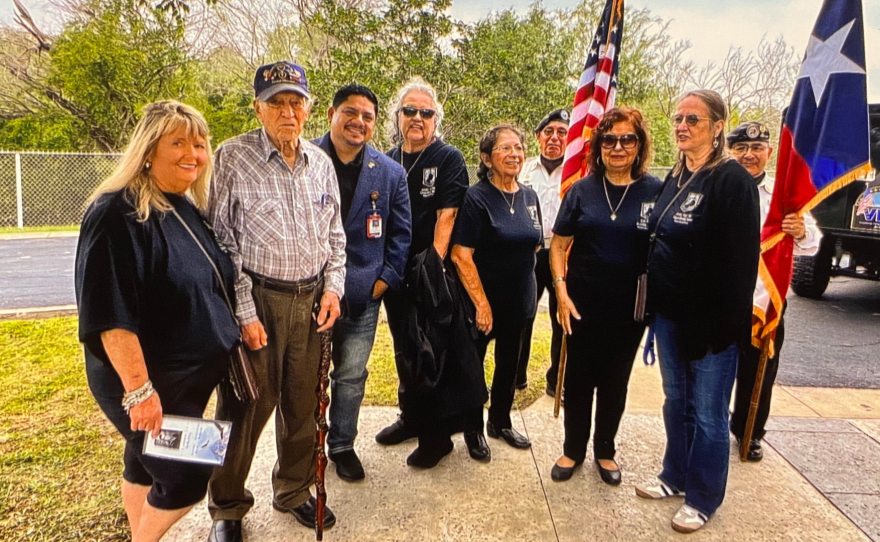

That story, finally told after nearly 80 years, inspired audiences and Mendez's comrades in arms.
Michael Black, a Vietnam War veteran and friend to Mendez, watched him go from being unable to share his combat experience to sharing his story during a hall of honor induction ceremony at a local veterans museum.
"While he was talking my thoughts went to the man that I had met the day before, who could not even think about the war, much less talk about it," he said. "And at that point, when I realized what Mr. Mendez was doing, I tapped Martha on the shoulder. I said, 'Do you realize what you have done for this man?' "
"RudyTejano" Peña, a veteran of both the Vietnam and Gulf Wars, was there with Mendez as he was honored: first with his commemorative flight earlier this year, and then again during the induction ceremony.
"Mr. Mendez has been inspirational to me because I'm also a veteran, and I can relate to a lot of his stories," he said. "I feel honored that I have been part of what is it? His voyage, or his trip now, as of reaching the age it is that he's reached."
Mendez entered the war in his teenage years to serve his country in the Armed Forces. Now 101 years old, he continues to serve his country by honoring the sacrifices made by himself and fellow veterans.
Copyright 2026 KEDT
