

This Monday night at 7 p.m., the Tobin Center for the Performing Arts is bringing nine artists and musicians together for one night for what they’re calling an American Revival.
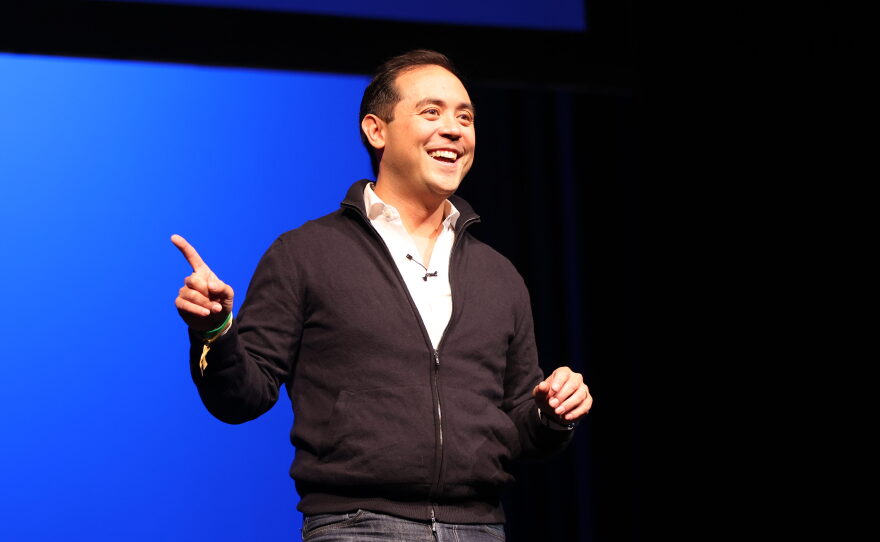
Nicholas Ma, son of the famed cellist Yo-Yo Ma, is organizing the event.
"The revival is this sort of very American tradition," Ma said by Zoom. "This notion that perhaps if I come to this place on this day, perhaps my life might change forever, right? And we wanted to sort of say, well, what does that look like? What would that look like in today's language and today's vernacular?"
Local singer-songwriter Lisa Morales signed up to be a part of the American Revival right away when she was asked.
“They're not sending a message politically. They're not sending a message as far as religion, but it is community, so it is spiritual in that sense," Morales said.
While not a religious event, the night models itself on the faith tradition, according to Ma.
"I think there's a lot we can learn from how services work in lots of faith traditions, right? There's always readings, there's always music, there's always sort of a sermon of sorts, right? There's always a moral call. There's always a question of, are you ready to be together in this moment?"
With Los Lonely Boys, Arrested Development, Alfre Woodard, mariachi, rock, poetry, and more, the American Revival takes place on Monday night at the Tobin Center, with a special mural dedication and bell-ringing ceremony the day before, Sunday at 4 p.m. at La Zona on San Antonio's near West Side.
American Revival takes place on Monday, Oct. 5 at 7 p.m. at the Tobin Center for the Performing Arts, with the Festival of Helpers bookending the Revival from 5:30 - 6:45 PM before the program starts, and 8:45 - 9:30 PM once it concludes.
Read below for an extended interview with Nicholas Ma, edited for length and clarity.

Nathan Cone: So maybe tell me in your own words, what your American Revival idea is.
Nicholas Ma: This is my third time going around the country and talking to folks. The first time was with a movie I made called "Won't You Be My Neighbor?" about Fred Rogers, and [it was] such a joy to make that movie. And I think it brought people a lot of joy. But as I went around, there was this other little emotion that came in, the sense of maybe this is a time that's past us. Maybe we should have listened to Fred back then, and we'd be in a different place now. I wondered a lot about that, and it didn't it didn't quite sit right with me. And then I had the opportunity to make this movie, “Leap of Faith,” about another group of pastors from the Midwest coming together, and about their struggles, [to] sort of do the same thing. Like, what does it mean to really be a neighbor, right? To love each other. We went around the country with that movie, and people were really enthusiastic about it. But at the same time, there was also this sense of, if it's this hard for 12 Christian pastors to get along, what hope is there for the rest of us? And I realized … that we really needed to put it in the present tense, right? To sort of say, okay, well, what's happening in this room right now? Not what happened on film even a year ago or 20 years ago, 30 years ago, but what's happening right now in this room, and the revival is this sort of very American tradition. This notion that perhaps if I come to this place on this day, perhaps my life might change forever, right? And there's something beautifully American about that idea of saying perhaps on this day something might change, and we wanted to sort of say, well, what does that look like? What would that look like in today's language and today's vernacular? To say perhaps coming here today, something might change. So it's a combination like revivals of message and music, right? It's a lot of joy and it's all of that. But really, at the core, it's that same fundamental question to say what would it mean for us to tune out the noise of the world for a second, and listen to that still small voice inside of us in whatever language it speaks, and ask ourselves what would it mean for us to heed that voice in that moment, in this moment, and do we have the courage to do that?
The word revival itself, and you alluded to it just a second ago when you were talking about the “Leap of Faith.” It does have a religious or spiritual connotation to it right away. I think people would immediately associate it with those religious revivals of the past. So, how do you see the event connecting with the community in terms of that revival, and maybe you know people thinking like, "Oh, what is this all about?”
Nicholas Ma: Yeah, I mean, first of all, I think there's a reason that Christianity and other faith traditions have been around for so long. They offer something really profound, and maybe that still small voice within you speaks in the in the language of the Holy Spirit in the Christian tradition, maybe it speaks in the language of Fred Rogers. Maybe it speaks as just this emotional pull. I think that my feeling is, I bring my faith into wherever I am. I hope you bring your faith into wherever you are, and that faith doesn't need to … you get to tell me what that is. I'm curious what that is. I'm not going to tell you what it is, right? I'm not going to say, okay, and this is what the answer is. I can tell you what I've discovered. I can tell you what I've found in my life, and I hope that in sharing that, it's an invitation for you to share what you think about in yours. I think right now we're in a moment where we often sort of segregate these things off. Like, faith takes place over here. You know, church takes place over here, and like art takes place over here, and politics takes place over here, and science takes place over here. But really, we are … I'm just one person, and all that is taking place in my head at one time.
I can tell you what I've found in my life, and I hope that in sharing that, it's an invitation for you to share what you think about in yours.Nicholas Ma
So what does it mean for me to bring all of me into a room and say, okay, I'm an Episcopalian, I am a mixed-race kid, I grew up in New England. My grandfather was born in San Antonio. My dad's a musician. I'm bringing all that. I'm a filmmaker… all that into the room with me, and I'm saying, I'm so curious to get to know you as well. And if in that moment we create this thing that we've shared that will never happen again. You're never going to see Los Lonely Boys and Todd Rundgren and Lisa Morales and Alfre Woodard on the same stage again. It's never going to happen again. One night only, October 5, right? If we can share something that no one else in the universe shares, maybe I can believe that all of me can be in the room with all of you, and I think that's sort of a beautiful thing. I think saying, "Oh no, no, you know, it's a revival, so you can only come if you're Christian,” or “it's a political event. You can only come if you have this political affiliation,” or whatever it is. It asks people to leave part of themselves behind, and then the question is always, when I pick up that part of myself when I go to the coat check and pick up that part of myself, do I still think I would feel the same things that I felt when I was in there or not? And I'm willing to take the bet that if we bring all of ourselves, we'll walk out and say, "Yeah, that's something I can believe in.”
Well, you say “one day only,” but it's not just the Tobin performance, although that's the key aspect that we're talking about here, but I think there's a something happening the day before as well. Maybe you can tell me a little bit more about this dedication of artwork.
In every city there's something that's in the water that is hard to talk about, right? When we were in Cape Cod and working with the Wampanoag Nation, it was November, and we were talking about Thanksgiving. You know, not a dozen miles from where the first Thanksgiving took place. Working with the Indigenous groups that had been at that first giving and had been telling very different stories for 400 years, right? And they said, "Look, we need to have the courage to say what would it mean to take the story and tell it again now, but in a more honest way that can lead us to the future?”
As we've been spending time in San Antonio, this question of family detentions continues to come up in every in every conversation. San Antonio has been disproportionately affected. You know there are tens of thousands of people who have been inside these detention centers down near Dilley and Karnes, and I think we felt strongly that if we're going to be in a community, we have to be able to talk about the most difficult things … the way that these centers have really affected the community in multiple ways, not just the ways in which it separates people from their livelihoods, from their families, but also the way that people who work there have to have these compartmentalized lives, the way that having these detention centers near your community, like the town in Dilley, all of a sudden isn't just a small town that's struggling to get by. It's the site of this place of national spotlight, and you know all of these things mean we have to talk about it, and we have to ask ourselves if we were to tune out all of the noise, all the national questions, all the political questions, all the policy imperatives, and just ask ourselves: What does that still small voice say? What would it say? And what would it allow us? How could it simplify this question for us in some way?
And I think we talk about the power of art in terms of music and the way that it allows us to sort of experience something together. There's something powerful in the visual arts as well, right? There's something arresting about looking at an image at a portrait and saying, "Oh wow, this forces me to contend with the humanity of this other person and to ask myself, 'What does that mean? What does that mean to me?’” But just like music, I can't tell you the answer, right? You're gonna have to come and make a decision for yourself. But I hope when you do, it gives you the sense that there is something that you can do, and everything that we do, we always make sure that there's something we can offer that you can do, no matter how small, just so that it's clear you can take a first step right now. So the revival, we have postcards, and we have an opportunity for people to write half of a postcard, either to send a kindness into the world or put their address on one and get one back. Say, look, this is your first act of faith in this moment of saying, look, I don't know what this is going to do, but it's worth doing. And at the mural, we're going to have a bell, a chance for people to say, look, I'm going to memorialize my having been here by ringing this bell. And is it going to change the world? No, but it's going to be a sound that we put out into the world that not only I will hear, that you will hear, that others will hear, that the people around me will hear, and a chance to say, okay, what I do in the world has a ripple effect, and I can hope that those ripples will extend beyond where I can see. October 4, from four to eight. I think it's at La Zona.
Oh my gosh, it's like next door to the radio station.
No, really? Oh, that's amazing. Well, come out there and ring a bell! I [want to express] my gratitude to San Antonio as a city. You know, I didn't know much about it. I knew it was where my grandfather was born, but he didn't live here for very long. And I came back, and you know. I don't know Texas very well. I don't come from Texas. … It wasn't a place that I was really familiar with. I knew that it beat to its own drummer, but that's about what I knew. And in coming there, I realized that quality is really beautiful. That sort of willingness to say, okay, we have a perspective that's all our own, and we're going to figure it out and make decisions on our own. And I think there's a lot of courage in that. There's a lot of courage in a moment where it feels easier to be part of some kind of flock than it is to sort of say, "No, I'm going to I'm going to find my own way.” And I think if we trust people to find their own way and listen to the moral voice inside them, even if I don't know why you're doing and it doesn't make sense to me, but if I can trust that you're doing that and you can trust that I'm doing that, I think something really beautiful might happen. And maybe that's the Texas experiment ... if we really trust each other to make those good decisions on our own.
Learn more about the American Revival: A Traveling Festival of Hope and Connection here.
Information about the event in San Antonio can be found here.
