Sign up for TPR Today, Texas Public Radio's newsletter that brings our top stories to your inbox each morning.
On an unseasonably warm February federal holiday, about 300 protesters flooded the streets of downtown San Antonio in opposition to recent actions by Immigration and Customs Enforcement in Minneapolis and throughout the country.
The student-led protest took place on Presidents Day, when many students have the day off from classes. The attendees included middle school students, high school, college, parents and retirees. It was organized by San Antonio Students for Peace with the goal of ending local cooperation with ICE.


Monday’s march began outside of the San Antonio City Council Chambers in Main Plaza. Several speakers from area high schools denounced ICE saying the agency and its staff are not welcome in San Antonio.
The protest comes after students at several schools staged walkouts in January. Dakota Ray Fausto, one of the organizers of this protest, said they chose Presidents Day as the majority of these students had the day off from school.
“We want to show that despite the narrative that students are only participating in these walkouts and these protests to skip school, that we are here because of our community, because we care, because we're impacted, and we see all these students that showed up today despite the fact that school is not in session,” she said.


Those walk-outs led to denouncements from Governor Greg Abbott and Attorney General Ken Paxton. The Texas Education agency issued a directive in February saying schools that assisted in walkouts could face an investigation.
"School systems have an obligation to ensure students attend school and remain safe. With news of student walkouts happening across the state, this guidance is a reminder that students are not free to engage in speech that disrupts the school learning environment,” the notice said.
On Monday, Paxton followed through saying his office was investigating San Antonio’s North East ISD and two other districts.
Fausto said that the agency directive was meant to suppress student voices.
“We think that state repression means we're doing something right. When we see that the governor is realizing the work these students are doing and is threatening it. That means we're getting attention,” she said. “We're actually building a viable movement, and we hope to see more of that and continue to show up in spite of that.”
The afternoon’s demonstrations began with a press conference-style assembly of students airing their opposition to ICE. Daniel Perez, a local high school junior, told attendees that this was a peaceful protest but not a silent one.
"We are not here because we hate America, (but) because we love it enough to demand better. We love it enough to challenge cruelty disguised as fear, fear mongering disguised as policy, and division disguised as leadership,” he said. “We love it enough to say that no government should rule by intimidation, and no community should live in constant fear.”

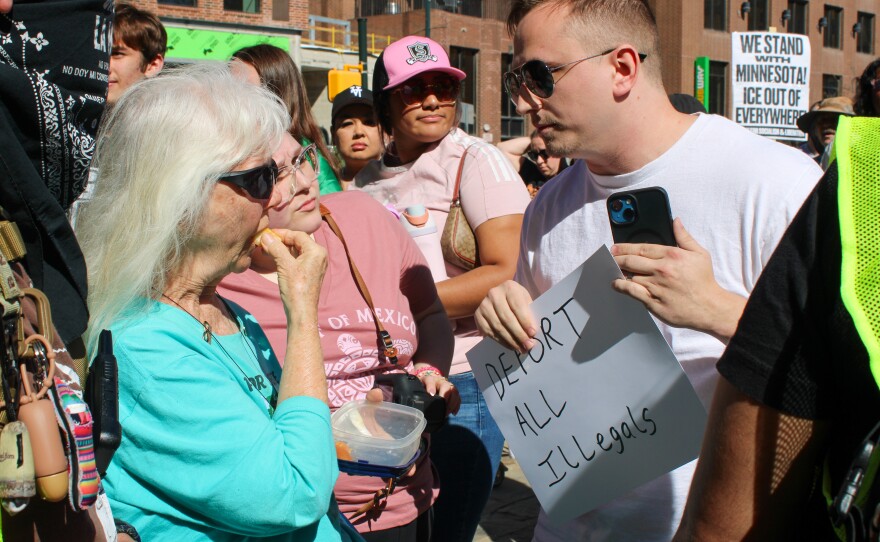

Monday’s protests also come as the City of San Antonio recently passed a resolution to examine what power it had to resist some ICE interactions in the city including the recent purchase of a warehouse on San Antonio's East Side that would serve as a detention center.
San Antonio Police provided an escort that closed traffic to certain roads along Flores and Houston Streets as the protesters left Main Plaza and marched to the Alamo.
Jay Doyle, 14, attended the march with her mother and siblings. She participated because she doesn’t want to see anyone deported because of racial profiling.
“I don't want someone to have to be scared of going to school because of it. I don't want someone to be frightened of stepping outside of their homes, wondering that their parents could be taken away once they step back inside,” she said.


Near the Alamo several state troopers were in riot gear blocking the entrance to the grounds, but the protest continued without incident.
Kia Mitchell-Scott participated in the march with her two daughters. She said she wanted to support them in protesting and encouraged others to get involved as well.
“I know it can be scary, especially bringing your kids, but through history, we've seen children and young adults change the world, and we should be here supporting them, because it's their legacy, right? We're leaving them this future, and we want to help them secure it,” she said.